
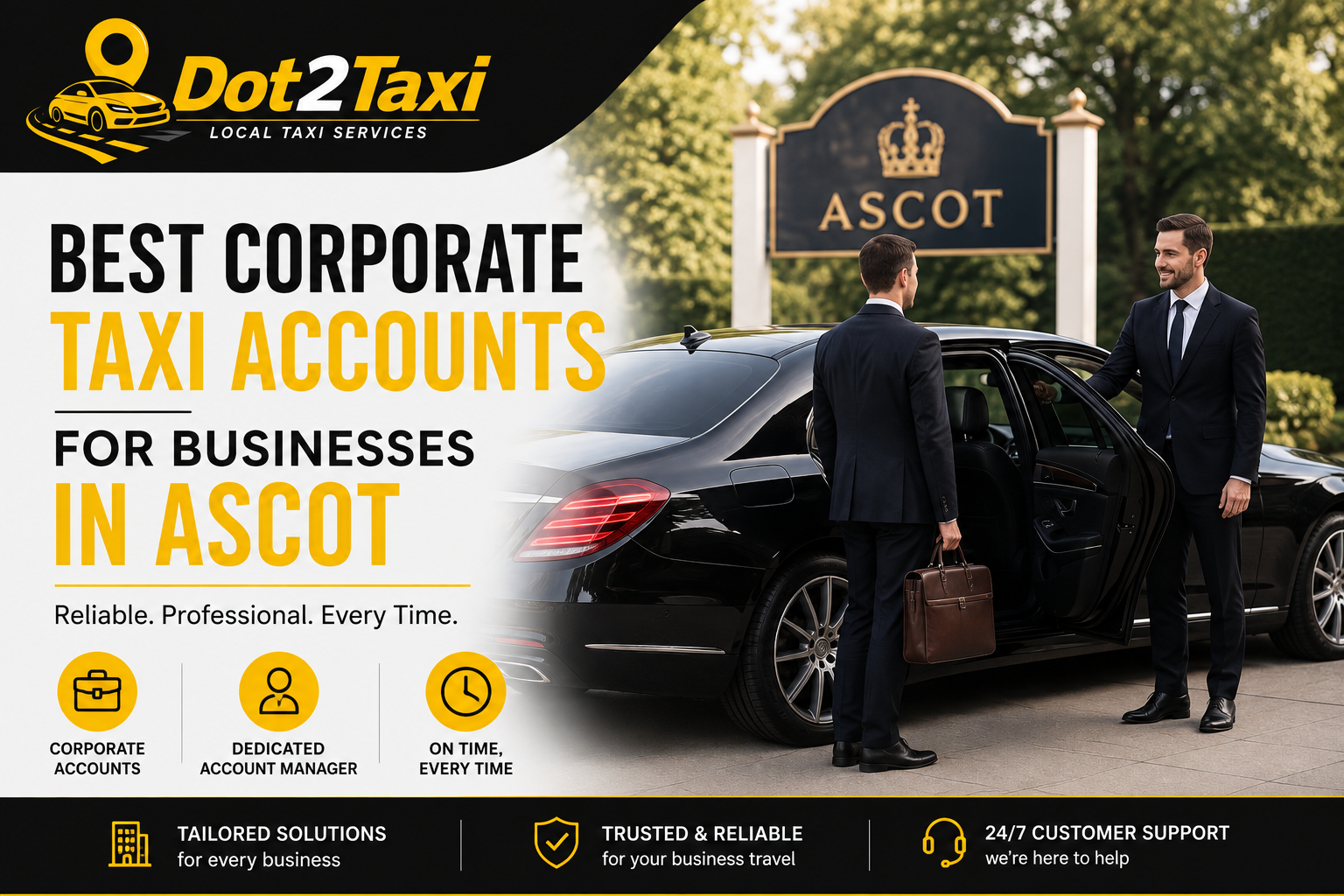
Corporate transport in Ascot is shaped by something no other Berkshire town deals with in the same way: an event calendar that periodically takes over the entire road network.
Royal Ascot, Guards Polo at Smith’s Lawn, and the racecourse’s wider fixture list generate enormous hospitality demand. For businesses based here, that means a corporate account has to handle two very different requirements: routine daily travel, and hosted event days where the transport is part of the client experience.
A corporate account is not a discount card. It is an operational arrangement, and the difference between a good one and a token one shows up in the invoicing, the standby pricing, and the account terms rather than the headline fare.
How this list was compiled: providers were identified from current business listings for corporate, executive, and airport transport in Ascot and the surrounding area, filtered to those with a verifiable trading address and an established local presence.
1. DOT2Taxi
Operating across Windsor, Maidenhead, Slough, and the wider Thames Valley since 1986, DOT2Taxi provides corporate accounts with fixed route pricing, consolidated invoicing, cost centre coding, and named account management. Coverage includes Ascot alongside fixed rates to Heathrow, Gatwick, Luton, and Stansted, plus daily business travel, client collections, and event transport.
Nearly four decades in this area means Ascot’s dual requirement is already understood. Routine travel is priced fixed and invoiced cleanly. Event days are handled with standby pricing agreed in advance rather than negotiated at the end of the afternoon. Every driver is fully vetted, and airport collections include real time flight tracking as standard.
Best for: Businesses wanting fixed route pricing for routine travel alongside proper standby terms for hospitality days.
2. Ascot Cars
A long established Ascot operator based at Station Hill, running 24 hours across corporate travel, airport transfers, and race week work with a substantial local fleet.
Being based in the town is a genuine operational advantage during race week, when approach roads congest heavily and an operator travelling in from further out loses time before the journey starts. Fleet scale also matters when several bookings fall on the same day.
Best for: Businesses needing local scale, 24 hour availability, and race week capacity.
3. Executive Travel Ascot
An Ascot based executive and chauffeur operation working across corporate travel and hospitality, with in car amenities provided as standard.
Proximity to the racecourse is a genuine advantage on race days, when local knowledge of alternative approach routes determines whether a client arrives on time or spends thirty minutes stationary on the A329.
Best for: Ascot based corporate hospitality and businesses hosting guests around the racecourse.
4. Cooper Executive Cars
A smaller Ascot based executive operator working across corporate journeys, airport transfers, and local business travel.
Smaller operators often deliver a consistency that larger firms cannot guarantee, since the same small group of drivers covers the same clients. The trade off is contingency if a vehicle becomes unavailable at short notice.
Best for: Businesses wanting a consistent, small operator relationship for regular travel.
5. Luxury Executive Cars
A Windsor based executive and chauffeur operation covering Ascot, running 24 hours across corporate hospitality, race days, and client entertaining.
Hospitality transport differs fundamentally from routine business travel. It involves standby waiting rather than point to point pricing, unpredictable finish times, and a vehicle standard that reflects directly on the host.
Best for: Corporate hospitality, race days, and client entertaining where presentation carries weight.
6. Abico Executive Travel
An executive travel operation covering Ascot from a Maidenhead base, working across corporate journeys, airport collections, and long distance business travel.
Executive operators occupy a specific position in the corporate market. The vehicle standard is consistently higher than a general fleet, which matters when a client is in the car.
Best for: Executive travel where consistent vehicle standard across repeat bookings matters.
7. First Class Chauffeurs
An Old Windsor chauffeur operation covering Ascot, working across executive travel and group bookings with larger vehicles available for events.
Discretion is the defining requirement at this end of the corporate market. For senior travellers taking calls or reviewing documents in transit, a chauffeur who understands when not to speak is worth more than any interior specification.
Best for: Executive travel where discretion and the ability to work in transit matter most.
8. Shadow Carriage
A chauffeur and group transport operation covering Ascot, with a fleet spanning executive saloons through to sixteen seater vehicles.
Holding both individual chauffeur capability and genuine group capacity means one operator can cover an executive collection and a delegate group on the same day rather than requiring separate arrangements.
Best for: Corporate groups needing genuine capacity alongside executive presentation.
9. Windsor Cars
One of the longest established operators in the area, covering Ascot with broad service across airport runs, business travel, and local journeys.
Longevity in this market is meaningful. An operator trading in the same area for decades has weathered demand cycles that see newer entrants come and go, which matters when you are signing a multi year account.
Best for: Businesses wanting a long standing local firm with scale and broad coverage.
10. ABC Mini Coaches
A 24 hour group transport operator covering Ascot, running minibuses and executive coaches across corporate travel, airport transfers, and event work.
For businesses regularly moving delegate groups rather than individuals, an operator holding genuine group capacity avoids the cost and coordination burden of booking several cars.
Best for: Delegate group transport and corporate events requiring minibus or coach capacity.
The Two Requirements an Ascot Account Has to Cover
Most corporate accounts are built for one type of journey. In Ascot you need both, and they price completely differently.
Routine business travel is point to point and predictable. Airport transfers, client collections, station runs, and journeys into London. This should be priced as fixed rates on named routes, invoiced monthly with cost centre coding.
Hospitality and event days are not point to point at all. A race day involves a morning collection, a full day of vehicle availability, and a return whenever the group decides to leave. Pricing this as a journey rather than a day is where accounts go wrong and where unexpected charges appear.
Agree both structures at account setup rather than discovering the gap on the first race day.
Race Day Logistics Your Provider Should Already Know
Ascot’s event days reshape the local road network, and an operator who has not worked them will find out on your client’s time.
- Temporary traffic management and one way systems activate from 10:00am daily during Royal Ascot
- The A329 and A332 congest heavily from around 11:00am as visitors converge
- The final approach to the racecourse can add twenty to thirty minutes at peak arrival
- Drop-off points differ by enclosure. Tell your operator which enclosure your guests hold tickets for, because dropping Royal Enclosure guests at the wrong entrance adds a long walk in formal dress
- Official racecourse parking is limited and priced accordingly, which is why hosted groups increasingly move to chauffeured arrival with standby collection
The same principle applies to Guards Polo at Smith’s Lawn and other Windsor Great Park fixtures, where access is spread across a large site with limited parking near the grounds.
What a Corporate Account Should Actually Provide
The fare is the easy part. These are the terms that determine whether an account works across a year:
- Consolidated invoicing on a monthly or fortnightly cycle rather than individual receipts
- Cost centre and project coding against each journey line
- Passenger name recorded against every journey for audit purposes
- Fixed agreed rates on your regular routes, particularly Heathrow
- Day hire and standby pricing for event and hospitality work, agreed separately from point to point rates
- The ability to bill a whole programme to a single event or client reference
- A named account contact reachable early morning and late evening, when event work actually happens
How to Judge Quality Before You Sign
Vehicle standard and consistency. Ask what vehicles are allocated to your account and how old they are. When guests are aboard, consistency matters more than any single vehicle.
Who is actually driving. Ask whether drivers are employed by the operator or whether work is subcontracted at busy periods. On a race day, subcontracting is most likely and most consequential.
Event experience. Ask directly which enclosure drop-off they use and how they route when the A329 backs up. The answers reveal whether they have worked race week before.
Standby pricing. Ask how a full day with an unpredictable finish is priced, and get it in writing before the first event booking rather than after it.
Exit terms. Ask about notice periods and performance provisions before you sign rather than after service declines. A trial period of one to three months is entirely reasonable to request.
The Standards a Professional Operator Should Meet
- Driver vetting. Professional drivers should hold enhanced background checks appropriate to carrying passengers.
- Vehicle maintenance. Vehicles carrying passengers commercially are subject to regular inspection requirements. A serious operator can tell you their schedule.
- Any vehicle carrying passengers for payment must hold hire and reward cover.
- Named accountability. You should have a direct account contact rather than a general enquiry line.
- Journey records. Every journey logged, which is what an auditable travel policy actually requires.
The Ascot Routes Worth Fixing
Heathrow transfers. Roughly thirty to forty minutes depending on terminal and traffic. This is the highest volume corporate route from Ascot and should be your primary fixed rate.
Gatwick. A longer run but regularly needed. Price it rather than leaving it ad hoc.
Central London. For early starts, late finishes, client collections, and anything involving luggage or equipment.
Ascot Racecourse and Windsor Great Park. Day hire with standby rather than point to point pricing.
Windsor, Bracknell, and the M4 corridor. Regular enough cross town movement to warrant agreed rates.
Station transfers. Short, frequent, and easy to leave unmanaged. They accumulate.
Why Choose DOT2Taxi
Longevity in this industry is evidence rather than marketing. DOT2Taxi has run corporate accounts across the Thames Valley since 1986, through decades of route changes, event calendars, and shifting business travel patterns.
That experience shows in the account structure. Routine travel is priced fixed and invoiced with cost centre coding because finance teams ask for both. Event days are handled with standby terms agreed in advance rather than negotiated at the end of the afternoon. Ascot week traffic is planned around rather than discovered.
Every driver is fully vetted. Every vehicle is maintained to a consistent standard. Every journey is logged, which is what an auditable travel policy needs.
How We Are a Better Choice
Ascot’s corporate market splits into three types of provider.
Executive chauffeur firms deliver excellent presentation for hospitality and race days, but pricing is generally applied uniformly rather than tiered by journey type, which is expensive across routine staff travel.
Local taxi fleets offer strong availability and local knowledge, but account infrastructure varies considerably. Some provide genuine consolidated invoicing and reporting. Others simply send a monthly bill.
Booking apps and platforms give convenience but no account management, no fixed route rates, no standby pricing, no cost centre coding, and no accountability when a driver cancels on a client collection.
DOT2Taxi combines local scale with genuine account infrastructure across both requirements. Fixed route pricing for routine travel, proper day hire and standby terms for event work, consolidated invoicing with cost centre coding, and a named contact reachable when hospitality days actually run.
Conclusion
Ascot is well served for corporate transport, and several operators on this list run genuinely strong services. Executive firms suit hospitality and client entertaining. Local fleets suit routine travel and race week capacity. Group operators suit delegate movement. Established operators with real account infrastructure suit businesses wanting predictable costs across both routine and event travel.
Before signing anything, ask five questions: what fixed rates can you agree on our top five routes, how is a full event day with an unpredictable finish priced, which enclosure drop-off do you use at the racecourse, does your invoicing carry cost centre coding and passenger names, and what are the notice period and exit terms.
The second question is the one most accounts get wrong, and the one that produces the invoice nobody expected.
Frequently Asked Questions
Q1. What should a corporate taxi account in Ascot include?
Fixed rates on regular routes for routine travel, separate day hire and standby pricing for event and hospitality work, consolidated invoicing with cost centre coding, passenger names for audit purposes, and a named account contact reachable at the hours event work runs.
Q2. How should race day and hospitality transport be priced?
Day hire with standby rather than point to point, since the vehicle must remain available across an unpredictable schedule. Agree the structure at account setup rather than negotiating it at the end of the afternoon.
Q3. When do traffic restrictions start around Ascot Racecourse?
Temporary traffic management and one way systems activate from 10:00am daily during Royal Ascot, with congestion building on the A329 and A332 from around 11:00am. The final approach can add twenty to thirty minutes at peak arrival.
Q4. Where should corporate guests be dropped at Ascot Racecourse?
It depends on the enclosure, and the drop-off points differ. Tell your operator which enclosure your guests hold tickets for when booking, since dropping at the wrong entrance adds a substantial walk in formal dress.
Q5. How long is a corporate transfer from Ascot to Heathrow?
Typically thirty to forty minutes depending on terminal and traffic. This is the highest volume corporate route from Ascot and should be your primary fixed rate on any account.
Q6. Does a corporate account help with duty of care?
Yes. A managed account with vetted drivers, insured vehicles, and logged journeys provides an auditable record demonstrating reasonable steps were taken. Ad hoc booking through consumer apps provides no equivalent evidence.
Q7. How long does it take to set up a corporate account?
Typically a few working days, covering rate agreement on your main routes, standby pricing for event work, billing and cost centre setup, and account contact assignment. Ask for a trial period before committing to an extended notice term.